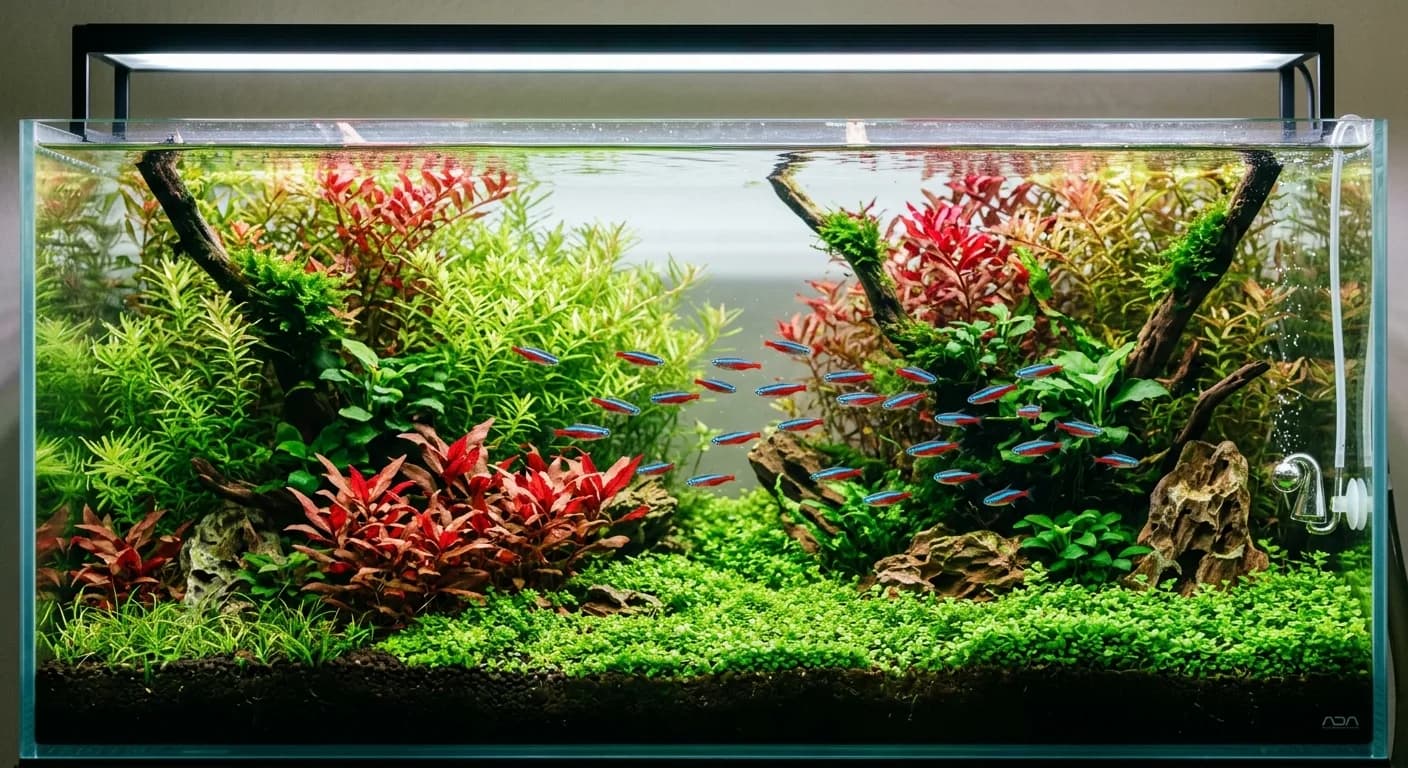
Best LED Light for a Planted Aquarium
The shop light over your tank is probably the reason your plants are melting. Most starter LEDs put out enough lumens to look bright but the wrong spectrum to drive photosynthesis. Plants need red and blue, especially in the 660nm and 450nm bands, plus enough PAR (photosynthetically active radiation) at substrate level to actually reach the bottom. Here are three LEDs that hit those numbers, picked for high-tech tanks running CO2, mid-range community planted tanks, and tight budgets where you still want plants to grow.
Our Picks
Fluval Plant 3.0 LED Light
Best OverallThe Fluval Plant 3.0 is what serious planted-tank keepers buy when they want a light they will not have to upgrade in a year. Full spectrum with strong red and blue peaks, programmable through Bluetooth, and enough PAR to grow demanding stem plants and red carpets at depths up to 24 inches. The Plant 3.0 will run a high-tech CO2 tank or coast on a low-tech one. The app handles ramping, color tuning, and a 24-hour cycle without a separate controller. Costs more than the others, lasts longer than the others.
Pros
- • Strong PAR at substrate level, grows red and carpeting plants
- • Bluetooth app for spectrum tuning and 24-hour scheduling
- • Sleek slim profile, no bulky cooling fins
- • Adjustable mounting brackets fit rimmed and rimless tanks
- • Drives high-tech tanks but dims down for low-tech
Cons
- • Highest price of the three picks
- • Bluetooth app has a learning curve, manual mode is clunky
- • Some users report driver failure outside the warranty window
NICREW SkyLED Plus
Best Mid-RangeThe NICREW SkyLED Plus is the sweet spot for a low-to-medium tech planted community tank. Full spectrum 6500K white plus 450nm blue and 660nm red diodes, wired controller for ramping and dimming, and enough PAR to grow Java fern, Anubias, swords, vallisneria, and most stem plants without CO2. Sized for tanks 30 to 36 inches at 30 watts; the 48-60 inch model bumps to 45 watts. About a third the price of the Fluval and grows the same easy-to-medium plants almost as well. Will not push the demanding red plants the Fluval handles.
Pros
- • Full spectrum with proper red and blue peaks for plant growth
- • Wired controller with ramp up and dim down
- • Programmable schedule including weekends
- • Adjustable mounting feet fit most tank widths
- • Strong value at less than half the Fluval price
Cons
- • Wired controller is less elegant than a Bluetooth app
- • Not enough PAR for high-tech CO2 tanks with red carpet plants
- • Mounting feet feel flimsy on glass over 1/2 inch thick
Hygger Auto On Off LED
Budget PickThe Hygger gets you into a real planted-tank LED for the price of a fancy dinner. Full spectrum with 7 color modes, a built-in timer, and an LCD controller that handles sunrise, midday, sunset, and moonlight cycles. PAR is lower than the NICREW or Fluval, so plan to stick with low-light plants like Anubias, Java fern, Java moss, and crypts. Will not grow carpet plants or anything red. The auto-on, auto-off feature is the real win for someone who forgets to plug in a timer. Built-in waterproofing is rated IP68, which means it tolerates splashes that would kill cheaper LEDs.
Pros
- • Lowest price of the three picks by a wide margin
- • Built-in timer and 24-hour cycle, no extra controller needed
- • IP68 waterproof rating, survives splashes and condensation
- • LCD display makes scheduling easy without an app
- • Six moonlight color modes for night viewing
Cons
- • Not enough PAR for demanding plants or carpet plants
- • Spectrum is biased toward white, less red than premium LEDs
- • Build quality is plastic, expect a 2 to 3 year lifespan
How to Pick a Planted Tank LED Without Wasting Money on the Wrong Spectrum
PAR matters more than lumens. Lumens measure brightness as the human eye sees it. PAR measures the light wavelengths plants actually use for photosynthesis. A bright shop-light LED can have high lumens and almost zero usable PAR. The Fluval Plant 3.0 puts out around 100 PAR at substrate level on a 20 inch tall tank at full power. The NICREW SkyLED Plus runs around 50 to 70 PAR at the same depth. The Hygger drops to 20 to 35. For low-light plants you need at least 15 PAR. Medium-light plants want 30 to 50. High-light tanks with CO2 need 60+ PAR at substrate.
Match the light to the plant ambition, not the tank size. A 75 gallon stocked with Java fern, Anubias, and a few crypts grows fine under a Hygger. A 20 gallon long with red plants, dwarf hairgrass, and pressurized CO2 needs the Fluval or it will sulk. The most common mistake is buying a budget LED for a tank that has carpet plants on the wishlist. Carpet plants need light at substrate level and a budget LED cannot deliver it through 18 inches of water.
Watch the tank depth. PAR drops off sharply with water depth, roughly halving every 12 inches. A 12 inch tall tank running a NICREW SkyLED Plus has plant-growing PAR at the substrate. The same light on a 24 inch tall tank barely reaches with low-light PAR. If your tank is over 18 inches tall and you want anything beyond Anubias, the Fluval is the safer pick.
Photoperiod matters more than peak intensity. Plants need 6 to 8 hours of light per day, no more for low-tech tanks, no less for any tank. Longer photoperiods grow algae before they grow more plants. All three of these picks have built-in timers or app-based scheduling. Use them. A 7 hour photoperiod with a 30 minute ramp up and ramp down is the safest default for a new planted tank. Increase only if the plants are growing well and there is no algae.
Light is one variable, not the whole equation. Even the best LED will not save a tank with the wrong substrate, no nutrients, or no CO2 in a high-light setup. If you upgrade the light without upgrading nutrients, you will grow algae instead of plants. Match light, nutrients (root tabs or liquid ferts), and CO2 (or no CO2) as a system. Cranking light alone is the fastest way to a green hair algae problem.